
Access-to-justice watchdog Courtready tracks every Canadian court and tribunal decision in which generative AI produced a fabricated citation. There were seven such decisions in 2024. There were 87 in 2025. In the first six months of 2026 alone, there were already 74. Eighty-one percent involved self-represented parties. That left 19 percent, or 32 decisions, involving lawyers who should have known better.
The same month that data appeared, the Law Society Tribunal in Ontario issued the largest costs order issued to date against a lawyer for AI-fabricated case references. In Mazaheri v. Law Society of Ontario, 2026 ONLSTH 112, the tribunal ordered $31,150 in costs, finding that the lawyer had filed motions using AI-generated materials – a factum, supplementary factum, affidavit, and supplementary affidavit – without checking the output, producing citations to cases that didn’t exist and real cases that had nothing to do with the points being argued.
A separate Ontario Superior Court decision, RSR Road Surface Recycling v. Bonnechere Excavating et al., 2026 ONSC 698, saw counsel admit to using AI to prepare a factum that cited a nonexistent quote from a Court of Appeal case and inserted principles that didn’t match the findings of another case it cited.
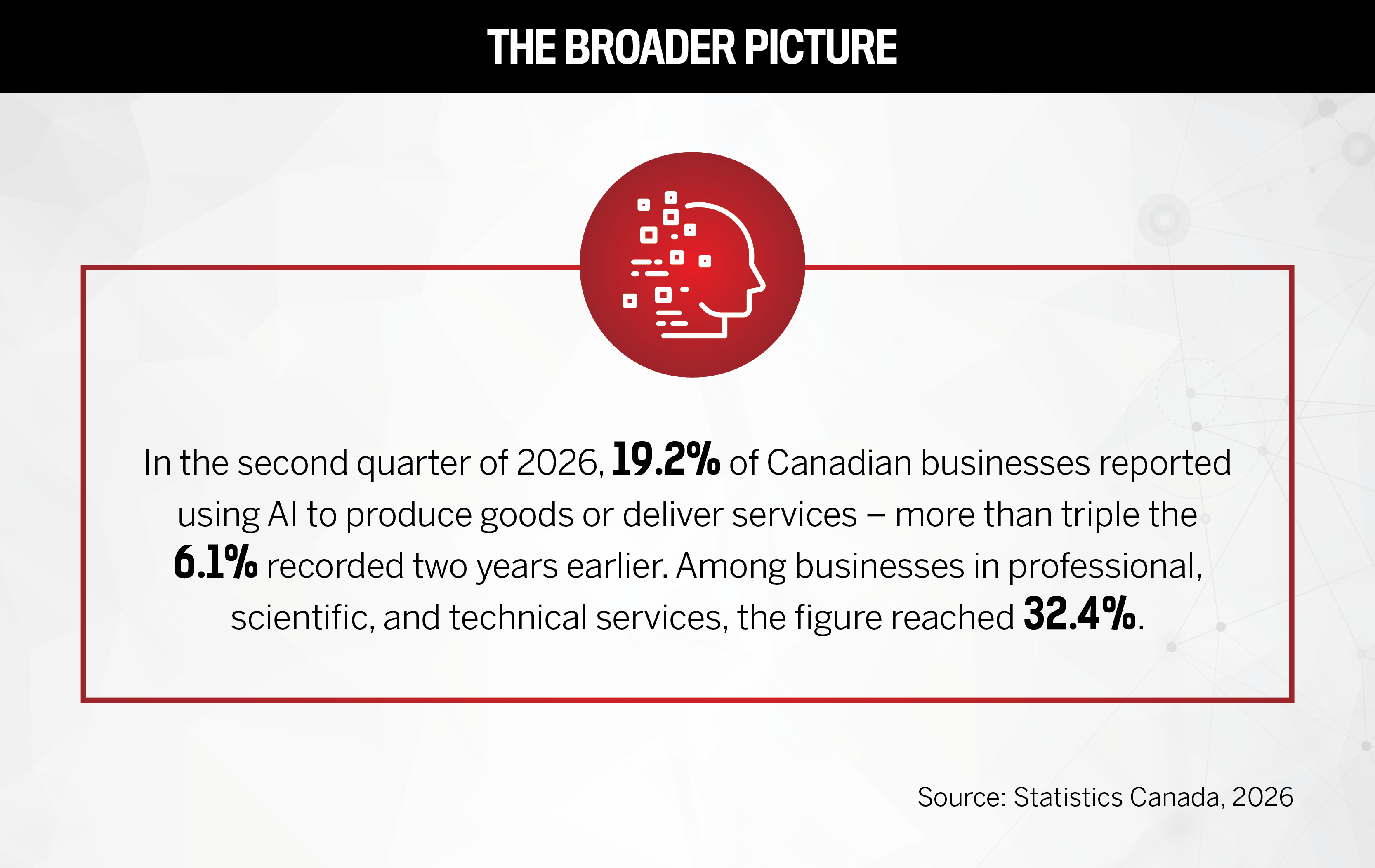
This is the Wild West. And yet it’s the environment in which 95 percent of Canadian legal professionals say they’re now using AI, according to Clio’s 2026 Legal Trends Report.


The pace of adoption has run well ahead of any frameworks designed to contain it. Bill C-27’s Artificial Intelligence and Data Act died on the Order Paper when Parliament prorogued in January 2025 and has yet to be reintroduced. The Minister of Artificial Intelligence and Digital Innovation, Evan Solomon, has confirmed AIDA will not be reintroduced, saying Canada needs regulation that’s “light, tight, and right” rather than a direct revival of the previous bill.
The result is a current patchwork of governance that predates AI entirely, such as federal PIPEDA obligations and Quebec’s Law 25 for automated decision-making transparency. The voluntary ISED Code of Conduct for generative AI was rolled out to address some of the concern, but it lacks teeth. None of the sector-specific directives that have come about since were written with legal practice in mind.
Law societies are carrying most of the weight by default. The Law Society of Ontario (LSO) updated its AI guidance in January 2026, with British Columbia and other provincial bodies issuing new or refreshing existing positions in the same period. The LSO’s 2026 budget allocated dedicated funding to CanLII’s generative AI project, a partnership with Canadian law societies to develop an AI-powered legal research tool grounded in verified Canadian legal sources. As for the courts, they’re arriving at their own answers: Ontario Superior Court practice directions issued in February 2026 addressed AI use in proceedings.
The data security dimension runs alongside the hallucination risk and is, so far, less visible. The joint investigation by Canada’s federal and provincial privacy commissioners into OpenAI’s ChatGPT, published in May 2026, found that the tool’s initial training violated Canadian privacy law through over-collection, invalid consent, and inadequate individual redress. Many Canadian firms’ primary AI interface is a general-purpose consumer tool, which has serious implications for legal professionals trying to keep pace with the technology's advancement.
In many cases, the lawyer has no real visibility into where that data goes or how long it’s retained, not to mention how it might be used to train the models they’re querying. For firms without a formal AI policy – and the research suggests most still fall into that category – this is an on-the-ground, daily exposure, not a theoretical one.
“Unlike general-purpose tools, a legal-specific platform carries data-handling guarantees and is built on a firm’s actual practice data, not the open internet,” says Luke Slan, general manager at Clio.
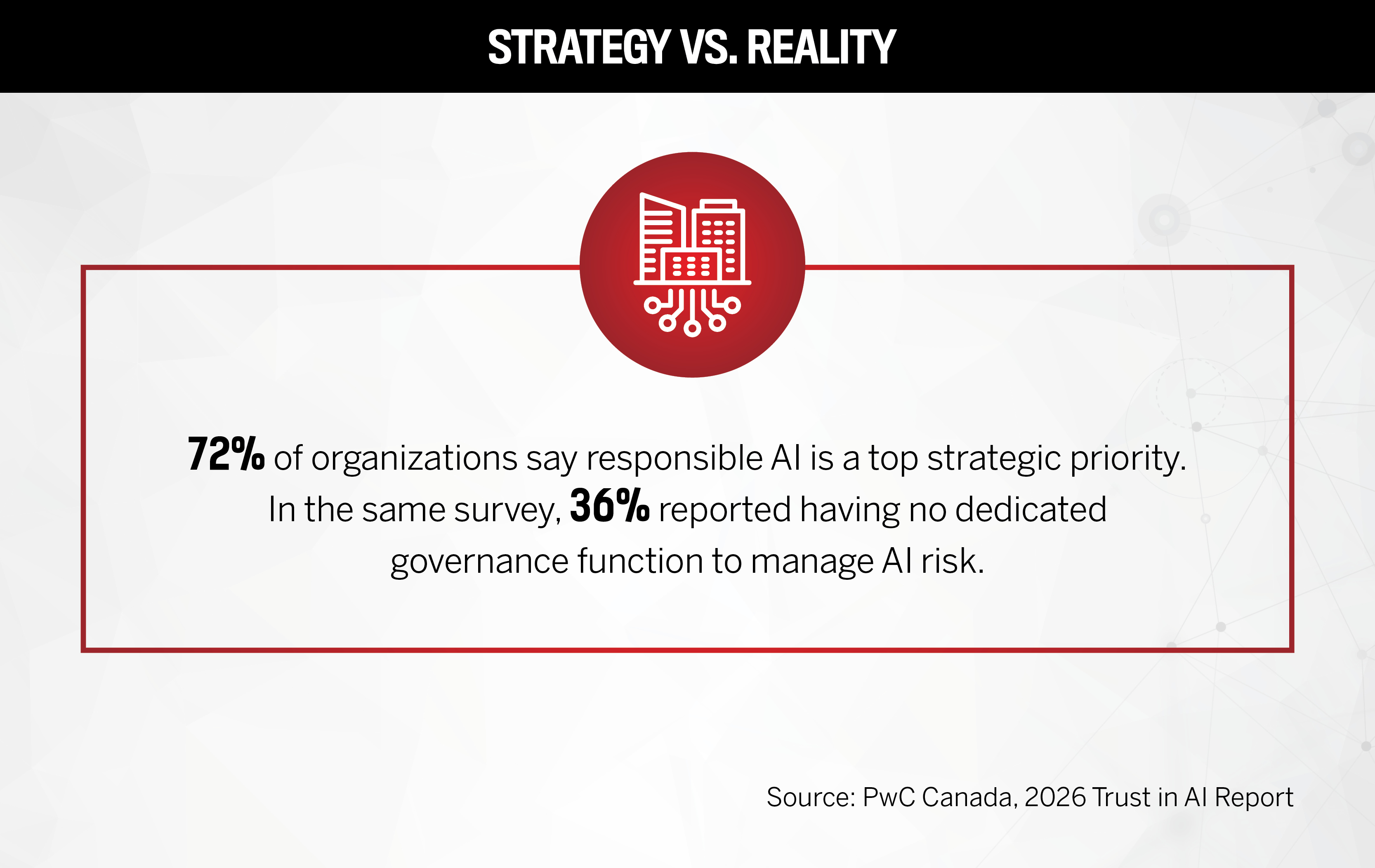
Larger Canadian firms aren’t waiting for the regulatory picture to clear. They’re moving oversight inhouse. Treating AI as a governance question instead of an IT decision, many are creating dedicated AI governance roles with explicit mandates to develop responsible AI frameworks.
This is a welcome adjustment that reckons with the now-central problem: while adoption is near-universal, there’s a difference between it and integration. Slan notes that the current frontier is restructuring how lawyers work around AI.
“After a law firm chooses the right tool, the next challenge they face is developing a system that turns individual AI use into a firm-wide practice,” says Slan. “Right now, a lot of firms have 20 lawyers, each experimenting on their own, instead of one firm-wide approach that is trackable, scalable, and that maximizes the benefits for both lawyers and clients.”
The automation of legal grunt work is a boon for efficiency, but it’s creating a skills crisis: junior lawyers are skipping the tedious tasks that once taught them from the ground up how the law works. Document review, research, and drafting are the most easily automated, but that routine work was what produced judgment by accumulation. As AI absorbs that associate-level work, a bottleneck is emerging. The only constraint on output is the experienced partner who still has to review it, no matter the speed at which it’s churned out.
One senior practitioner called it the “AI training conundrum”: “If you’re not doing that lower-level work, how do you then graduate to the higher-level skills that you will need to be a partner and a senior lawyer?”
Where does the next generation of reviewers come from? The automation chips away at what the profession needs to bring to bear at this moment, which is lawyers who can evaluate AI output with enough depth to catch what it gets wrong. And it’s running out of road to produce them. In response, law schools are taking a hard look at what needs to change in order to adapt to the realities of the profession. Western University’s faculty of law recently debated at a conference whether AI should become a core competency in a Canadian law degree. No consensus was reached, but the debate is only on track to intensify.
While there is no negotiation on establishing AI – having the technology in place is now a top priority for talent, with Clio’s data finding 74 percent of legal professionals say AI has made them more likely to stay at their current firm – the ground that needs settling is how to do it properly. Slan argues that success hinges on leaning into the time it frees up and adjusting the way the next generation of lawyers are taught.
As AI absorbs more of the mechanical work, he says, “The lawyer’s value shifts further toward judgment: knowing which facts matter, how to advise a client through uncertainty, and how to use AI tools to build a strong case strategy”.
Slan explains, “For that shift to work in lawyers’ favour, the profession needs to be deliberate about two things: training new lawyers in judgment and client counsel skills earlier, passing some of the efficiency gains back to lawyers as more interesting work and greater business development opportunities.”