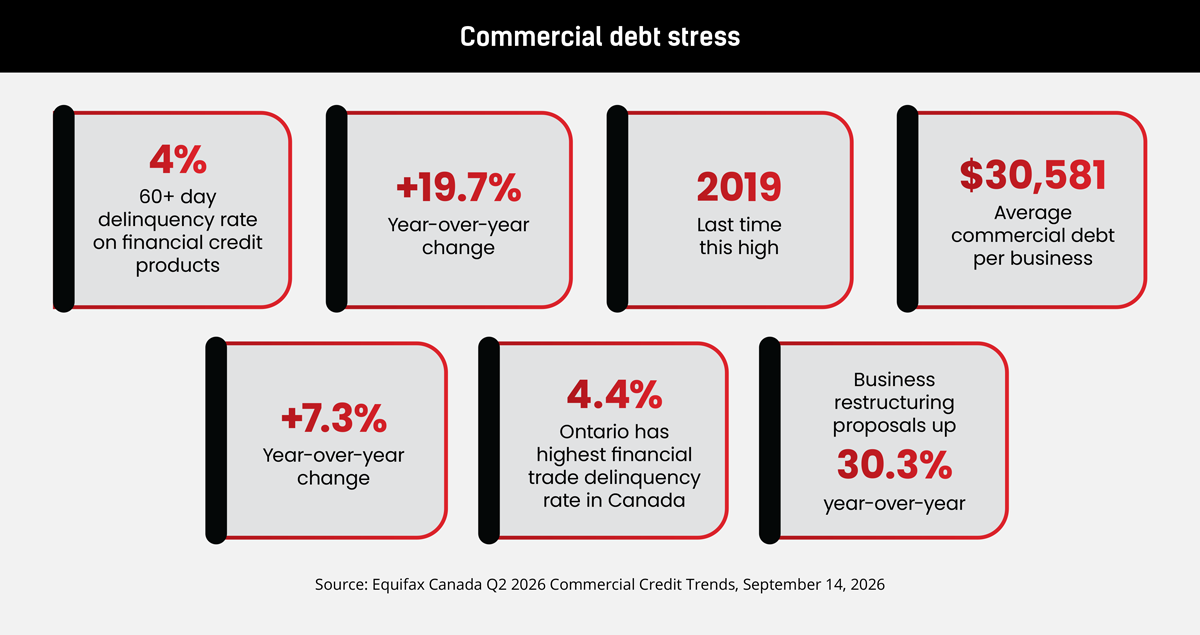
According to Equifax Canada’s recent commercial credit trends data, the 60+ day delinquency rate on financial credit products among Canadian businesses reached four percent in the second quarter of 2026, the highest rate since 2019 and a 19.7 percent increase year-over-year. Average commercial debt per business climbed 7.3 percent over the same period to $30,581.
The pressure is concentrated, with increases most pronounced among higher-risk businesses, and Ontario recording the highest financial trade delinquency rate in the country at 4.4 percent.
“The data continues to show an important divide in how Canadian businesses are managing their financial obligations,” says Jeff Brown, head of commercial solutions at Equifax Canada, in the September 2026 release.
For creditors’ counsel, that divide shows up on the enforcement docket: more businesses in arrears, more commercial debtors who have assets and are not paying, and more enforcement files arriving without a clear plan for collecting what a court has already awarded.
The businesses driving that delinquency trend are not, for the most part, insolvent. They have corporate structures, operating accounts, and real property. They have also learned, with increasing precision, how to delay, obstruct, and outlast a creditor who has already won in court. That sophistication has outpaced how most creditors’ counsel plan for enforcement.


Most civil litigation practice is built around the pursuit of judgment. Enforcement is treated as what comes after, something that will sort itself out once the hard work of winning is done. For creditors’ counsel doing commercial debt work in Ontario right now, however, that framing is costing clients money.
Between the legal conclusion and money in a client’s account sits an enforcement process that requires procedural precision at every stage: writs of seizure and sale registered against real property, notices of garnishment served on financial institutions, examinations in aid of execution compelling disclosure of assets, contempt proceedings when a debtor refuses to comply. Each step depends on successfully serving the right party at the right time. A process server who does not understand that sequence, and what is at stake at each point in it, is a liability.
“In the Greater Toronto Area, judgment enforcement is no longer a paperwork process; it’s an intelligence operation,” says Sonny Jaggi, CEO of Dial and File Process Servers Inc., a Toronto process server and legal support firm with more than 15 years of experience in process serving, court filing, skip tracing, and document retrieval.
“Debtors are using multimillion-dollar corporate assets, cross-border digital platforms, and structural loopholes to hide in plain sight,” he continues. “If your process server is just knocking on doors between 9 a.m. and 5 p.m., they aren’t just missing the target. They’re tipping off the defence.”
Personal service is the mechanism that triggers Ontario’s most serious enforcement consequences, including contempt arrest warrants. It is also the bottleneck that commercially sophisticated debtors have learned to exploit. Evasion is not a passive strategy. A debtor who understands the rules knows that keeping a process server from completing service on a Notice of Examination or a Notice of Garnishment can delay enforcement indefinitely under the current framework, and they plan for it.
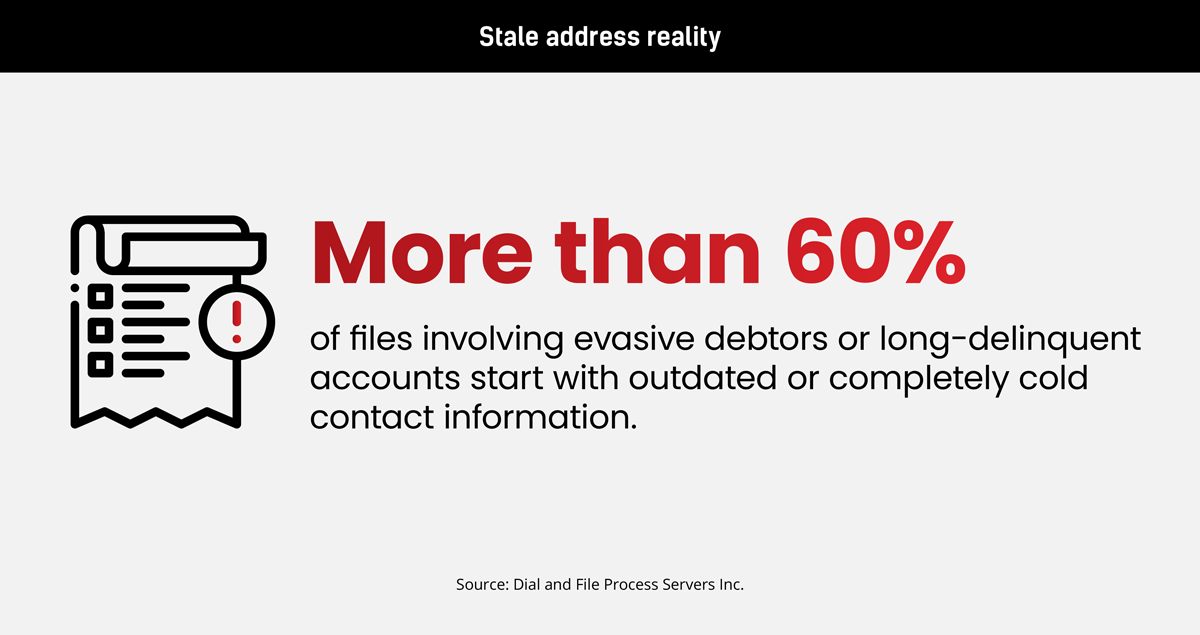
Enforcement work has changed in response. As a GTA process server, Dial and File handles files across every level of Ontario’s judicial system, from Small Claims Court through the Superior Court to the Court of Appeal, because a commercial enforcement file rarely stays at one level. Locating a debtor who does not want to be found has become as much a part of the service as the delivery itself: skip tracing through public records, Ministry of Transportation searches, and field intelligence before a server goes out.
GPS-logged documentation on every attempt creates the bulletproof record that keeps a file defensible months or years after service was completed. First-attempt success is the operational standard because in a commercial enforcement context, a failed attempt is not a neutral event.
Ontario’s enforcement framework has not kept pace with the on-the-ground reality Jaggi describes. The province’s Rules of Civil Procedure, which govern how judgments are enforced, have not been substantially updated in over 40 years. As written, they impose friction at nearly every step: creditors need court approval to issue writs and garnishments after six years, separate requisitions and affidavits are required for each financial institution in a multi-bank garnishment, enforcement costs are only partially recoverable, and the contempt route for non-attendance at examinations lacks a clear fast-track mechanism.
A commercial debtor who understands those procedural requirements can use that friction as a delay strategy, and the burden falls on the party who has already won to find ways to persevere. But the Civil Rules Review Working Group, which released its final report in December 2025, recognized the problem. It stated that a judgment is an ongoing obligation and delay should not shield a debtor. Enforcement should be fast, proportionate, and effective.
The proposed sweeping reforms to Ontario’s enforcement framework are the most significant changes for creditors’ counsel in a generation. The leave requirement to issue writs of seizure and sale and notices of garnishment after six years would be removed. A single requisition with a common affidavit would support multiple notices of garnishment against different institutions, replacing the current per-garnishee requirement. Enforcement costs would be fully recoverable at indemnity rather than partially capped. A streamlined contempt route would be introduced for failures at judgment debtor examinations, giving creditors’ counsel a faster path to compel compliance when a debtor refuses to attend or answer.
In its February 2026 analysis of the reforms, Lerners LLP said judgment creditors face “avoidable hurdles,” and the changes would deliver “cleaner rules, fewer dead ends, and better tools to compel compliance and recover money.” The enforcement-specific reforms are still pending formal approval by the Attorney General and Chief Justice, however. While some procedural amendments to the Rules took effect September 1, 2026, the enforcement overhaul that creditors’ counsel are waiting for has not yet arrived.
What the Working Group’s proposed reforms do not address is execution. Rules governing substituted service and asset disclosure are only as effective as the firm carrying them out – and most debtors know that the process server, not the legislation, is the variable they can exploit.
Closing that disconnect requires enforcement counsel and service providers who know the difference between delivering documents and executing service against a debtor who does not want to be found.
“A transactional server looks at a locked gate or a condo concierge as a dead end; an enforcement expert looks at it as a data point,” Jaggi says, adding that when a debtor evades service, Dial and File pivots directly to digital tracking, social media mapping, and lifestyle surveillance.
“We don’t wait for them to answer a doorbell,” Jaggi says of the approach his Greater Toronto Area process server firm takes.
When warranted and for an additional fee, the team can even map out a debtor’s private routine – their local gym, their private golf clubs, their corporate entities – and “execute personal service in the public sphere where their security arrangements cannot protect them.”
For firms doing commercial creditor work in Ontario, the lesson of the current enforcement landscape is the same one the Civil Rules Review Working Group articulated: enforcement strategy cannot begin after judgment. A plan for collecting needs to be part of the file from the point of claim.