


Jump to winners | Jump to methodology
Canadian Lawyer’s best pro bono law firms show what access to justice looks like when it is built
into the practice, not bolted on
Seventeen Canadian law firms and legal departments have been named to Canadian Lawyer’s 2026 5-Star Pro Bono Firms list, selected from 33 nominees by Pro Bono Ontario (PBO) and the CL editorial team. Pro bono legal work – free legal services provided to clients who cannot afford counsel – is becoming a matter of infrastructure in Canada. It needs to be, because goodwill alone is not keeping pace with demand.
CL’s fourth annual 5-Star Pro Bono Firms report identifies the best law firms and legal departments that have made pro bono a structural commitment rather than an occasional one.
The winners were selected across four categories, including large, medium, and small firms and in-house legal departments. Nominations were reviewed by PBO and the CL editorial team and evaluated on the depth of each firm’s pro bono infrastructure, senior and partner participation, treatment of pro bono hours within performance systems, and contribution to access to justice organizations. The report is proudly supported by PBO.
The 2026 survey findings, analyzed against four consecutive years of data, show a profession that has made the core structural decisions. Committees are in place. Senior lawyers are doing the work, not just endorsing it. Ninety-two percent of respondents confirm that partners and C-suite executives personally provide pro bono legal services.
Approximately 78 percent of respondents reported formal mechanisms to source and assess pro bono opportunities across all four survey years. The share of firms setting formal pro bono targets has risen from 15 percent in 2023 to 44 percent in 2026.
What remains unresolved is the staffing. Dedicated coordinator roles, the connective tissue between policy and practice, dipped from 65 percent of firms in 2023 to 55 percent in 2025 before recovering to 64.5 percent in 2026. Lawyer capacity remains the dominant barrier to participation by a wide margin, and it has been since the first survey year.
Ninety percent of callers to PBO’s Free Legal Advice Hotline say it is their first opportunity to speak with a lawyer about their legal problem. That figure defines the stakes.
In 2025, more than 1,500 lawyers participated in PBO projects, a 33 percent increase over 2024, demonstrating how structure, partnership, and shared purpose can unlock individual lawyers’ capacity to deliver meaningful, high-impact pro bono service at scale.
The volunteer lawyers served a record 38,480 clients, a 16 percent increase compared with 2024. In the first quarter of 2026 alone, PBO answered more than 10,000 calls through its Free Legal Advice Hotline.
“These figures underscore both the profound need for legal assistance and the meaningful impact PBO volunteers have,” PBO executive director Kirsti Mathers McHenry says. “We consistently hear from clients, including those who were not successful in their litigation, that access to legal help reduced anxiety, clarified next steps, and helped them move forward with confidence. The human impact of being heard by a trusted lawyer cannot be overstated.”
The firms celebrated here have answered that call through dedicated resources, leadership participation, and programs built to last beyond the goodwill of any single committed lawyer.
As PBO board chair Deb Templer explains, “The growing number of firms investing in formal pro bono structures signals strong potential for continued growth. The challenge now is to extend these practices to more mid-size and boutique firms.”
That challenge belongs to the whole profession. The 5-Star firms show what it looks like when a firm decides to meet it.
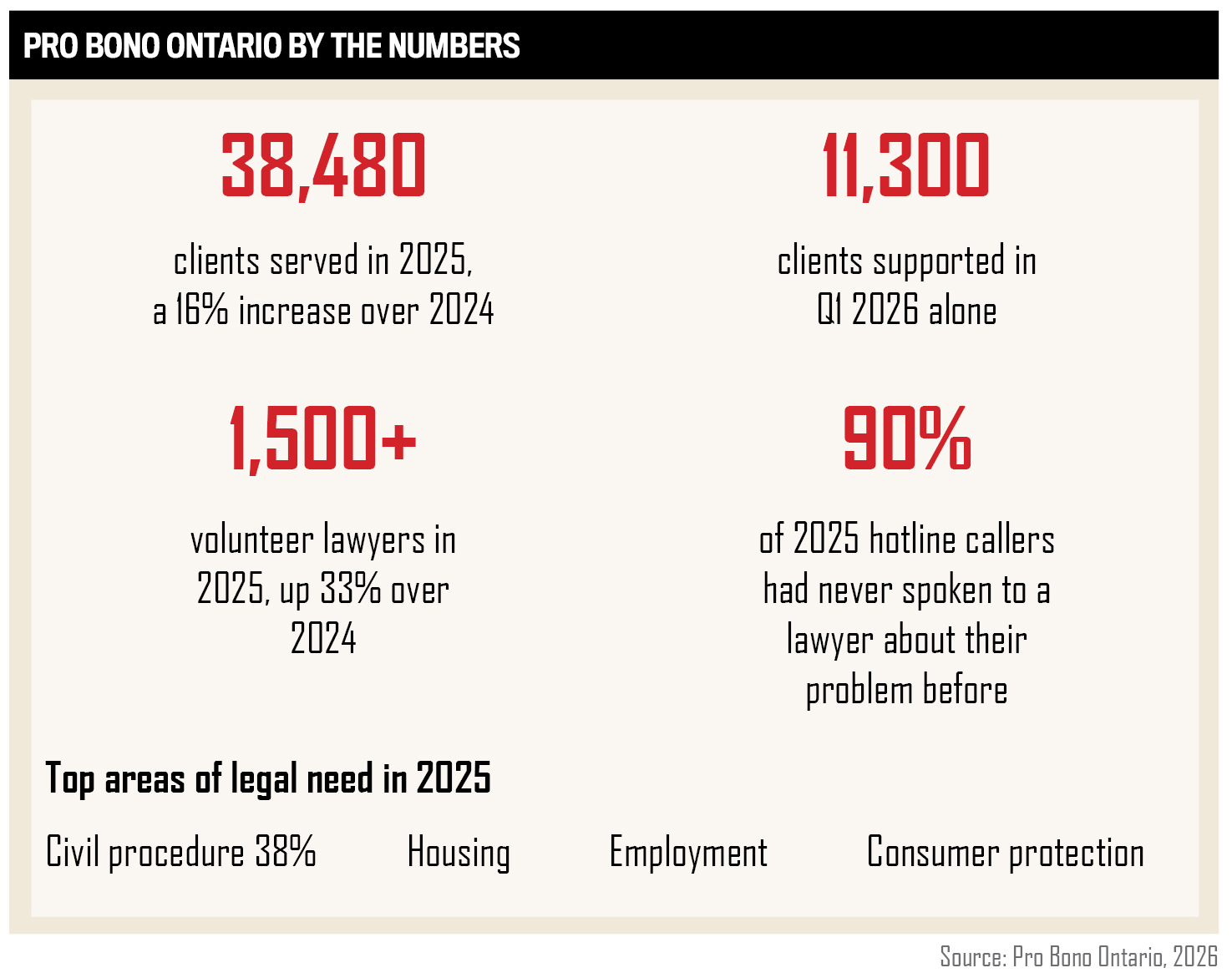
Pro Bono Ontario programme figures, 2025 year and Q1 2026. The gap between calls received and calls answered defines the scale of Canada's access to justice crisis.
Pro bono has moved from aspiration to operational investment at most Canadian law firms. The findings below draw on CL’s 5-Star Pro Bono Firms survey, conducted in partnership with PBO, which has tracked the same cohort of firms across four consecutive years from 2023 to 2026. The data show that structural commitments are embedded. Committees exist. Policies are in place. Senior lawyers are doing the work. What fluctuates is the human infrastructure underneath them.
Share of respondent firms with a full-time or dedicated pro bono coordinator. The 2026 figure restores a starting point, not a new high.
Share of respondent firms with formalized annual pro bono targets. The shift from aspiration to obligation is the defining structural change of the four-year dataset.
Barriers to pro bono participation rated on a weighted 1–5 scale (1 = low challenge, 5 = high challenge). Capacity has led by a wide margin since the first survey year in 2023.
Key structural and leadership commitments across respondent firms, 2026. The top line is consistent. The staffing layer underneath it is not.
Average annual pro bono hours per fee-earning lawyer, 2024. The 5-Star winners operate at a different standard from the broader Canadian market — but even Canada's best firms sit below global peers.
The coordinator trend is the most instructive data point in the dataset, and not for the reason the 2026 number suggests. At 64.5 percent, the share of firms with a dedicated pro bono coordinator appears to be a high-water mark. It isn’t. In 2023, the inaugural survey year, 65 percent of respondents already had one. The number fell through 2024 and 2025 before recovering. The infrastructure gains of 2026 restore a starting position rather than establish a new one.
That two-year slide matters. It suggests that coordinator roles, even at firms committed enough to pro bono to participate in this survey, are not treated as permanent infrastructure. They remain vulnerable to the same capacity pressures that dominate the barrier data year after year.
What has held steadier is the procedural layer. Across all four years, approximately 76 percent to 78 percent of respondents reported a formal mechanism to source and assess pro bono opportunities. The scaffolding stays up. The dedicated person to run it comes and goes.
Ninety-two percent of firms report that partners and C-suite executives personally provide pro bono legal services. That figure dismantles the assumption that pro bono participation belongs to junior lawyers building their files. At most of these firms, the most senior people are taking the calls, signing the pleadings, and sitting across from clients who have nowhere else to go.
Recognition and policy ownership are equally entrenched. Among firms where the question applies, 97 percent say partners formally recognize associate pro bono activity, and 91 percent say senior leadership owns pro bono policy across the organization.
Where the picture softens is in the structural layer. One in eight firms says senior leadership does not ensure mentorship and supports are available to lawyers doing pro bono work. The same proportion says partners do not sit on pro bono committees. Personal participation from the top matters. Committee seats and mentorship infrastructure are what convert that participation into a program that holds when the committed partner leaves or the caseload spikes. In 2026, most firms have built that layer. Not all have.
In 2023, 76.5 percent of respondent firms credited pro bono hours toward billable targets, the highest rate across all four years. That figure dropped to 61.7 percent in 2024, recovered to 71 percent in 2025, and settled at 66 percent in 2026.
The variation across years likely reflects differences in respondent pool composition as much as genuine behavioural shifts. What holds across all four years is that a clear majority of billable-hour firms formally credit pro bono time. That structural commitment has not wavered.
What has moved more decisively is the target-setting question. Only 15 percent of 2023 respondents set formal pro bono targets. By 2025 and 2026, that figure had risen to 35 percent to 44 percent. Firms are increasingly willing to formalize expectations rather than rely on encouragement, a change that affects how pro bono work is evaluated, tracked, and defended internally in ways that goodwill alone cannot.
The capacity barrier has dropped every year since 2023, from a weighted score of 3.55 to 3.13 on a five-point scale. The rate of decline, however, has slowed. The largest single-year drop came between 2023 and 2024. Since then, the line has flattened.
More telling than the decline is the gap. Insufficient expertise, conflicts of interest, and lack of opportunities have all converged near or below 2.0 in 2026. Capacity sits at 3.13, nearly a full point and a half above the next highest barrier. It is not one friction point among several. It is the friction point, and it has been since the first survey year.
The coordinator hiring trend is best read as a direct operational response to that constraint. Firms are not adding coordinators as a branding exercise. They are adding them because capacity does not resolve itself through culture and commitment alone.
Charitable giving to access to justice organizations was universal among 2023 respondents. It has since settled to 74 percent to 78 percent, a retreat that is almost certainly compositional.
Across four years, the data describes a profession that has made the structural decisions while still working out how to staff and sustain them. Senior participation is high. Formal mechanisms are in place. Billable credit is the norm. The coordinator dip and recovery is the clearest sign of that unfinished work. Pro bono is no longer a side activity at these firms. It is not yet fully resourced as a practice area either. And the coordinator dip is not the only sign of unfinished work: the generational thinning Kafka describes in criminal defence – the disappearance of mid-career counsel capable of carrying complex pro bono files – is a structural constraint that no coordinator role or policy resolves by itself.
PBO’s Free Legal Advice Hotline answered more than 10,000 calls in the first quarter of 2026 alone. In 2025, PBO engaged over 1,500 volunteer lawyers and served a record 38,480 clients. The demand has never been higher, and the gap between calls received and calls answered remains the central operating reality of access to justice in Ontario. It is also the reality that shapes how CIBC’s legal department approaches its pro bono commitment.
The department’s program is built around structured Hotline sponsorship events, run in partnership with external firms. The model puts CIBC lawyers and their firm counterparts in the same room, on the same calls, working through the same problems, an arrangement that generates professional exchange that formal business development rarely produces. The shared experience of helping callers in crisis builds lasting relationships, explains Hayley Peglar, senior counsel, legal researcher, and education specialist, who coordinates the organization’s pro bono efforts with partner law firms.
Underpinning the program is deliberate preparation. In-house lawyers at a major financial institution spend their days on specialized corporate, commercial, and regulatory work, and a reasonable worry can emerge that the legal issues reaching the Hotline fall outside their practical range.
CIBC addresses that directly, working with PBO to hold training sessions with past volunteers, familiarize lawyers with PBO’s content library, and establish that first-principles legal reasoning and client-counselling skills are precisely what callers need. The result is a team that arrives at Hotline shifts confident rather than hesitant.
There is also structural groundwork specific to the in-house context. In Ontario, lawyers with exempt insurer status have coverage to participate in Lawyers’ Professional Indemnity Company (LAWPRO)-approved programs, such as the Hotline, a point at which CIBC communicates clearly to remove a practical barrier that can suppress participation.
The department pairs that clarity with formal recognition. Volunteer hours on the Hotline trigger charitable grants through CIBC’s employee recognition program, and pro bono participation is embedded in annual reviews and professional goals. Pro bono initiatives are further supported through a 12-member volunteer inclusion and diversity team, sponsored by the vice president and deputy general counsel, focused on advancing access to justice alongside broader EDI priorities.
CIBC was among 42 legal departments from the financial and insurance sectors that organized or participated in the sixth annual Financial Institution Pro Bono Day in April 2025, partnering with fellow 5-Star winner Norton Rose Fulbright Canada and PBO, an event that brought together more than 1,150 volunteers industry-wide and served over 1,100 clients.
What I love about this initiative is that it is a rich experience for everyone involved. First and foremost, Hotline callers benefit from high-quality legal advice from excellent and caring lawyers.
But there are also huge benefits for the volunteers. Post-COVID, the profession is grappling with changes in how we work. Hotline shifts provide excellent in-person mentoring where junior lawyers get to hear senior lawyers in action during calls and learn from debrief discussions between calls. I also see “mentoring up” with first-year lawyers helping experienced lawyers with new technology or sharing recent case law they came across in research.
It’s an experience that lends itself to private practice lawyers of all career stages having an opportunity to interact with their in-house clients. The firms often provide lunch and a social hour, which offers a great debrief opportunity. This matters because we are sometimes interacting with callers in crisis on the Hotline, and that social time creates an environment of support for all volunteers.
In terms of relationship building, it’s a meaningful experience to work alongside one another to advance a shared value of access to justice. I think that sticks with people in a way other business development opportunities might not.
There can be a misconception that lawyers don’t provide pro bono services because they don’t care. In my experience, it’s the opposite. The hesitance often comes from a place of deep caring.
There can be a worry that there is a skills mismatch between the specialized work in-house lawyers do for their businesses and the types of legal issues the Hotline handles. In this case, it was an easy fix. We worked with PBO and internal champions of pro bono work to hold sessions to address this concern.
While it’s true we encounter legal issues on the Hotline that we don’t deal with in our day to day, our first-principles legal knowledge and client-counselling skills bring great value. Business insight and deep knowledge of contract, corporate and commercial, consumer protection, estates, and employment law are also highly relevant.
PBO also offers extensive volunteer support, including a content library developed and continuously improved by their staff lawyers and sometimes even in-person support from their volunteer coordinators. By having past volunteers share their experience, and by familiarizing our lawyers with these resources in advance, we ensure our team feels supported and ready to volunteer.
Recognition of pro bono efforts can look very different in the in-house context. While law firms have found success giving billable credit for pro bono hours, most in-house environments don’t operate with a billable hour model.
At CIBC, we are fortunate to have strong support from our leadership team for community involvement and pro bono service. CIBC’s volunteer recognition program rewards employees for their time volunteering on the Hotline by providing charitable grants they can contribute to charities of their choice. Our volunteer efforts are also encouraged, recognized, and rewarded through our annual reviews and professional goals.
I am very proud of the strong participation on the Hotline we have seen within our team and from our law firm partners and the positive impact it has had on Hotline callers. Often, the Hotline represents callers’ only opportunity to speak to a lawyer, and the advice they receive can be life changing. We have deep support from our leadership, with the most senior members of our team volunteering alongside the most junior members.
Most large law firms describe pro bono as a commitment. Norton Rose Fulbright Canada has built it as a practice. The firm was the first Canadian firm to appoint a full-time dedicated pro bono lawyer and one of the few to develop and implement a formal strategic plan for its pro bono program. That infrastructure shapes what is possible in ways that individual goodwill alone cannot.
The results reflect it. Norton Rose Fulbright Canada has received CL’s 5-Star Pro Bono Firm award for three consecutive years, from 2024 through 2026. It has won the Access Pro Bono Cup in both 2024 and 2025. In 2025, it received the Community Partner Award from Black Entrepreneurs and Businesses of Canada Society for a program it created to deliver pro bono legal services to low-income Black entrepreneurs, one of several structured projects the firm has built to extend its reach beyond individual casework.
The firm’s pro bono footprint spans housing rights, Indigenous justice, immigration and refugee protection, prisoners’ rights, environmental law, and minority-owned small business support. Its lawyers work with children and families at risk, as well as with organizations that cannot afford legal counsel. The firm also makes significant financial contributions to organizations advancing access to justice across the country.
That infrastructure recently enabled one of the most consequential pieces of constitutional family law litigation in recent Canadian history. On April 25, 2025, the Superior Court of Quebec ruled that provisions of the Civil Code limiting legal parentage to two parents were unconstitutional, violating section 15(1) of the Canadian Charter of Rights and Freedoms.
The court gave the Quebec government 12 months to amend the Civil Code accordingly. The Quebec government subsequently announced its intention to appeal the ruling; the outcome of that appeal will determine whether and when the amendment timeline proceeds. The ruling followed complaints brought by the LGBT+ Family Coalition and families who had been unable to list three parents on their children’s birth certificates.
Senior associate Michel Bélanger-Roy served as co-lead counsel, representing the Coalition and two of those families, work that required years of preparation, a full litigation team, and sustained firm support from inception to judgment.
Working with those families was essential, and it made us better lawyers. Our job in a case like that is to bring the voices of those families to court and to give those voices strength in the legal context. And to do this properly, we must first listen to the family. We must truly try to understand what they’re living, their challenges, and their concerns.
I would also say that working closely with the families and getting to know them is a powerful motivating factor. It gives you a very concrete illustration of why you’re doing this and what the impact is going to be on very real and loving families.
That time with them is precious, really helpful for us. And I think for them, too. It’s really helpful to see that they contribute and that they’re in direct contact with us. It’s not just giving us the case, and you do whatever you want with it. We are really a team with the families.
I like the cultural aspect of your question. The population here in Quebec, and elsewhere in Canada, already accepts a multitude of family models that deviate from the traditional biological marriage model.
Adoption, same-sex parenting, and single parenting were all accepted at different times and gradually over time. They are all examples of diverse family structures that can function very well for children’s development, and I think most of the population knows and recognizes that.
Multiparent families are something that’s a bit newer for most of us. Not everybody has been in contact with these families. But it’s just a continuation of the same idea of accepting that there is not just one family model.
What still needs to happen is that we must continue to maintain an openness to differences and a commitment to offering equal recognition to everyone.
I’d start by saying that our laws do a lot for marginalized people. So, I don’t want to say they always fail them. Our laws are already adapted in many, many ways, and we have to acknowledge that.
But it also often happens that some more disadvantaged or marginalized groups will be kind of forgotten by the law and will have more difficulty being heard by those who make the laws. What happens in those situations is that the laws are tailored for the majority, or for influential groups that can be heard more easily, rather than for all members of society. And I believe that often stems from a lack of listening, or a choice not to truly listen, from the people who have the power to make those laws.
It makes a really big difference. Maybe the most obvious way is that it creates new opportunities to get involved, because the firm will identify pro bono opportunities, matters, cases, or ways to contribute that I might not have found on my own.
But I’d say for matters I might identify myself with, it’s still enormously useful, because after you take on a matter, you need the firm’s support. And that structure gives you support, reinforcement, and recognition for the pro bono work you’re doing.
I’ve been working on some bigger, high-profile cases, like the one we’ve been discussing. When you do that, you obviously need a whole team and strong support from the firm to bring your efforts to fruition. Norton Rose Fulbright provides that support. It’s a privilege to be able to do pro bono work under these conditions.
Most law firms treat pro bono as a portion of a lawyer’s working life. Pink Larkin structured it as a full-time position. To the firm’s knowledge, it is the only law firm in Canada with a full-time, paid lawyer dedicated exclusively to pro bono cases on behalf of community organizations, a commitment that has been in place since social justice litigator Vince Calderhead joined from Nova Scotia Legal Aid in 2017.
The work Pink Larkin takes on is deliberately chosen for reach. The firm prioritizes matters where the outcome will shape future legal protections, inform legislative change, or strengthen social supports – cases where the impact extends well beyond the individuals directly involved. Over nine years, that focus has produced meaningful outcomes in social assistance, housing, and systemic reform. All lawyers at the firm are encouraged to contribute their time and expertise to those efforts alongside Calderhead’s dedicated practice.
The most significant result to date is Disability Rights Coalition v. Nova Scotia (Attorney General), 2021 NSCA 70, litigated through the Nova Scotia Human Rights Commission, the Nova Scotia Supreme Court, and the Court of Appeal.
Calderhead represented the Coalition in alleging that the province had systemically discriminated against persons with disabilities in the provision of housing. The case produced the largest general damages award for a human rights violation in Canadian history and has driven important and ongoing reform work in the fight to end the institutionalization of persons with disabilities in Nova Scotia.
Calderhead’s standing in the field runs well beyond Nova Scotia. He has appeared before the Supreme Court of Canada and has advocated before United Nations Human Rights treaty bodies in New York and Geneva. He teaches a long-standing course at Dalhousie’s Schulich School of Law on the intersection of poverty law and human rights, work that governments, the judiciary, and the bar recognize as the contribution of a reasoned and principled advocate.
I spent 31 years in legal aid, representing individuals on a case-by-case basis in income support and housing. What became clear by the end of that time is that systemic issues, such as challenges to laws, policies, and government practices, take a level of time and focus that is just not viable in a conventional legal aid practice.
It certainly wouldn’t be viable on a volunteer basis. People who want to make a voluntary legal contribution are typically not in a position to devote the hundreds of hours that systemic work requires over the years. That’s what this model makes possible.
Most often it’s when a challenge targets a law, a policy, or a widespread government practice. When you’re challenging a law that affects hundreds or thousands of people, the systemic impact is almost self-evident.
With income support issues, there are often internal departmental policies with the same broad reach. And then there are practices, ways of doing things that have developed over time without ever being formally written down, that can affect just as many people. Those are the three things I watch for: a law, a policy, or an entrenched practice that is failing low-income people at scale.
That case is interesting because we weren’t doing a Charter challenge to a law or seeking to strike something down. We were challenging the government’s practice of not following its own law. The relevant social assistance legislation required services to be provided in certain ways to qualified people. What we discovered, after studying government practices, is that they weren’t even doing that. That affected thousands and thousands of people with disabilities in Nova Scotia.
But the more important lesson is about the remedy. In 99.9 percent of cases, a court or tribunal renders a decision and closes the file. What made this case significant systemically is that we pushed for an ongoing remedy that will take five years to fully implement because it is system wide.
The Board of Inquiry is available to re-engage if the province falls short of implementation. There is an independent monitor reviewing progress annually. The Disability Rights Coalition can stay on top of it and hold the government accountable. The finding of discrimination matters. What you build around it to make sure things actually change matters just as much.
On the international side, human rights law in Canada, whether it’s Charter law or provincial human rights legislation, is increasingly influenced by what’s happening internationally. My work at the UN treaty bodies, and the work of others in that space, has helped build a body of law that Canadian courts are drawing on more and more to inform their interpretation of domestic law. That is a fairly direct example of how those two areas connect. The international work doesn’t stay international. It comes back and shapes what’s possible at home.
Self-represented litigants filed 34 percent of all applications for leave to appeal to the Supreme Court of Canada in 2024–25, according to the court’s own performance report – a figure that reflects a system-wide failure of representation that reaches from Belleville’s criminal courts to the country’s highest bench. Most pro bono programs are built on policy. Edward J. Kafka’s has grown out of four decades inside Ontario’s criminal courts, watching more accused persons arrive without meaningful legal representation.
Kafka has practiced criminal law exclusively since 1983 and is among a shrinking group of senior criminal defence lawyers still practicing in Hastings County. He is in his 43rd year of practice, and since 2023 he has significantly expanded the pro bono work he has always done.
The need in Hastings County is persistent and increasingly visible. The working poor who earn just above Legal Aid’s financial thresholds often cannot access a certificate. Accused persons facing charges where the Crown is not seeking custody are also routinely denied Legal Aid, regardless of the complexity of the case.
An impaired driving file, for instance, can require reviewing breath room videos, body cam footage, disclosure records, and machine setup procedures before a defence can even be assessed. Duty counsel, however capable, cannot realistically carry that level of review for every unrepresented accused moving through crowded criminal courts.
Kafka sees the consequences firsthand. Full-day case management courts, packed remand lists, and growing numbers of self-represented accused have become part of the daily reality in the region. What concerns him most is not only the lack of representation but also the speed at which people can be pushed through the system without ever receiving what he considers real access to justice.
Kafka steps into that gap. He takes referrals from mental health workers, drug treatment counsellors, Indigenous agencies, and individuals he encounters directly at the courthouse. He assesses whether the person genuinely cannot afford private counsel and proceeds from there, often without any expectation of payment and without counting the hours involved.
His firm previously ran open advice days on Saturdays, with up to three lawyers offering free counsel on criminal matters, Legal Aid applications, and Criminal Injuries Compensation Board filings. No retainer. No expectation of future business. The goal was simply to give people access to legal advice they otherwise would not receive.
When those colleagues moved on, Kafka continued alone. He has worked to encourage broader participation within the Hastings County criminal defence bar, though he says the obstacles are structural. Junior lawyers are already stretched on Legal Aid rates. Experienced counsel capable of carrying complex criminal files are becoming harder to find as senior members of the bar retire or move to the bench. Meanwhile, the clients who fall outside the system continue to arrive.
For Kafka, the issue is not abstract. He has seen cases where an accused person initially facing lengthy custody receives a dramatically different outcome once experienced counsel reviews the file properly. That, he says, is the difference meaningful representation can make.
I’ve always done it and my firm has always done pro bono work. Throughout my career, I used to get calls from the court to come in and help someone because duty counsel wasn’t available. So it was never not part of what I did.
What changed in the last three or four years is partly personal and partly what I’ve been watching in court. I’ve noticed a real increase in the number of people being charged who cannot retain counsel privately and do not qualify for Legal Aid. The case is too complex for duty counsel to handle on a summary basis, but the system processes them through anyway.
I’ve watched people try to represent themselves at trial on assaults, thefts, frauds, and impaired driving matters, and they simply don’t know how to do it. They don’t know how to cross-examine witnesses or assess disclosure properly, and ultimately, they lose. They never really get their day in court.
If someone approaches me in the courthouse hallway, and I can see they genuinely cannot afford counsel and cannot adequately represent themselves, I’ll say, ‘Set up an appointment.’ I’ll request disclosure and start reviewing it. Some of those files easily run 20 or 30 hours, sometimes much more. But I don’t count the hours. I just do the case.
At the end of the day, you get real moral satisfaction in doing what we were told we were doing when we were in law school, which is helping people just for the sake of helping them.
The problem is the bottom line. If you have a brick-and-mortar firm, your overhead is high. You have staff, computers, and rent. Even the most basic firm is going to spend at least $100,000 a year on overhead. And the lawyers I speak to, they’ll say, ‘I’ve got to pay my staff and feed my family’. I don’t blame them.
The bar has also greyed significantly. We call it the greying of the criminal bar. The senior lawyers have either retired or gone to the bench. We have a lot of lawyers at the one-to-five-year mark and very few between 10 and 15 years. The lawyers who have the experience to carry out complex pro bono work properly on impaired files, assaults, and break-and-enters are becoming a vanishing cohort.
And those cases require experienced counsel. Sometimes, duty counsel is told the Crown wants 12 months in custody. Then an experienced lawyer reviews the file and speaks with the Crown, and the result becomes 30 days’ time served. That’s the value experienced representation brings to the system.
I don’t think the Law Society of Ontario should make it mandatory. When it becomes mandatory, it is not coming from the heart. What I think would help is if the criminal lawyers’ association in each jurisdiction took it upon itself to identify the unrepresented cases and reach out directly to experienced members. And there could be structural incentives, such as credits on professional development requirements, or some reduction in errors and omissions insurance for documented pro bono work.
It’s a hard sell. But someone has to step in for people the system isn’t reaching. These people are presumed innocent. Sometimes they’re not guilty. And somebody has to establish that the Crown cannot prove its case beyond a reasonable doubt.
Many of the patterns emerging in CL’s 5-Star Pro Bono Firms research are also appearing internationally. The 2024 TrustLaw Index of Pro Bono found that firms investing in dedicated pro bono infrastructure continue to report materially higher participation levels and stronger long-term engagement.
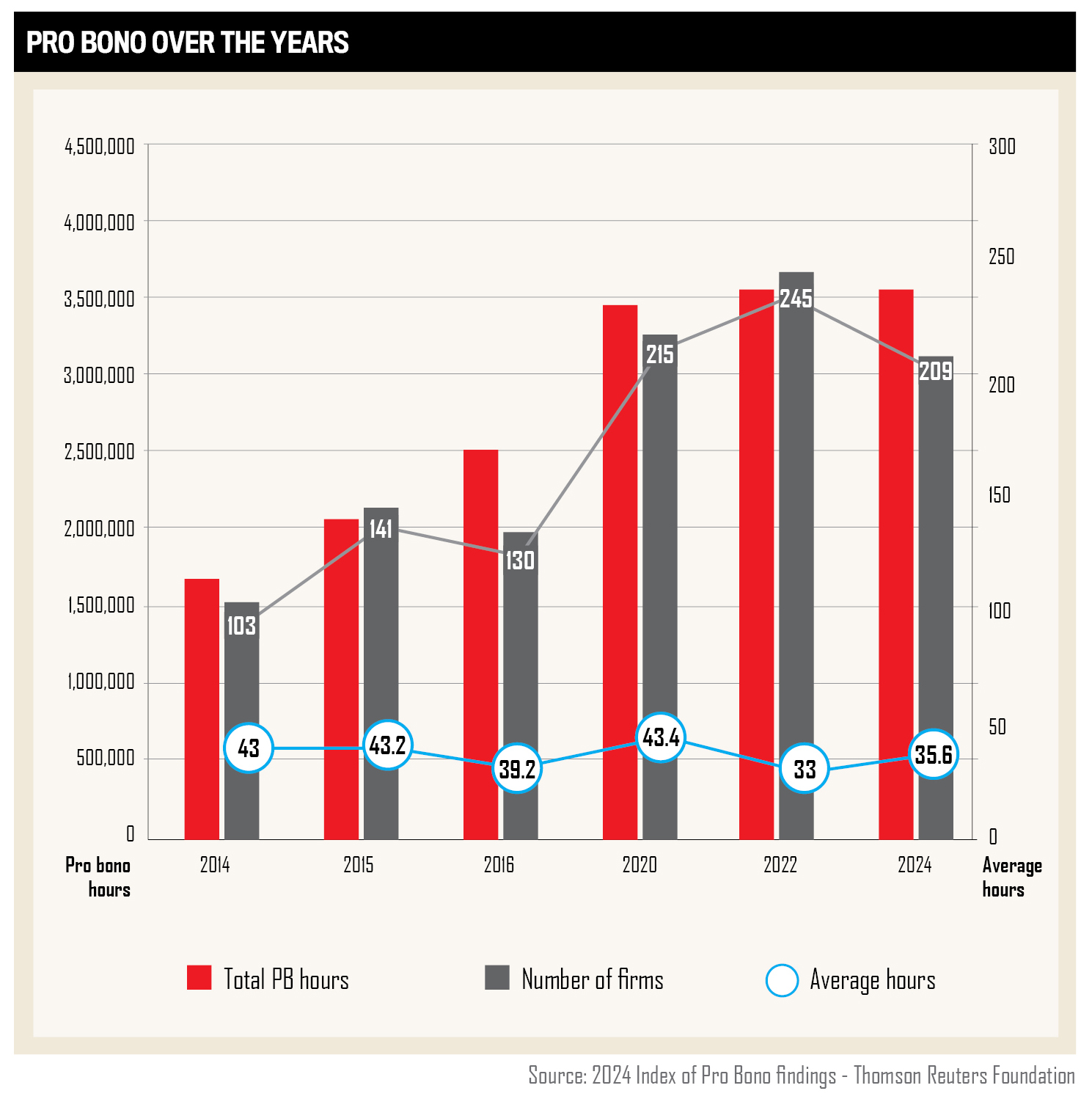
The global findings closely mirror what has emerged in CL’s data across four survey years, from 2023 to 2026. Pro bono work is becoming more operationally embedded inside firms, with leadership involvement, formal systems, and coordinator roles increasingly tied to participation levels.
Key findings from the TrustLaw report include:
Lawyers averaged 35.6 hours of pro bono work annually in 2024, up from 32 hours in 2022
80 percent of firms factored pro bono work into performance appraisal processes
68 percent counted pro bono toward fee-earning or billable targets
57 percent incorporated pro bono participation into compensation decisions
Firms with a designated pro bono coordinator reported nearly three times more pro bono hours than firms without one
Firms with standalone pro bono programs generated 52 percent more pro bono hours than firms where the work was combined with broader corporate social responsibility initiatives
The findings reinforce one of the strongest themes in CL’s survey data that firms treating pro bono work as formal legal practice infrastructure, rather than volunteer activity operating on the margins of practice, are seeing stronger participation and more durable engagement.
In Canada, that trend has appeared through rising coordinator numbers, sustained leadership participation, and growing use of formal targets and performance structures tied to pro bono work.
But the distance between the broader Canadian market and the firms recognized in this report remains significant. Where the average Canadian fee-earning lawyer devoted 9.9 hours to pro bono work in 2024, well below the global average of 35.6 hours, the 5-Star firms have built the structures that make sustained participation possible in the first place.
The TrustLaw data describes what the broader profession is doing. The best pro bono law firms in Canada – the firms in this report – describe what it looks like when a firm decides to do more.
PBO vice chairperson Mary Paterson says that Canadian firms that build strong pro bono programs tend to:
value excellence
have leadership committed to access to justice
model engagement at the partner level
create space for associates to participate
take pride in the impact their lawyers make
“Also, when firms allow their lawyers to source their own pro bono opportunities, it can lead to more diverse clients and matters as well as more excitement around the program,” she adds.
The organization is contributing by investing in ways to make pro bono participation turnkey for firms, regardless of internal administrative capacity, notes Templer.
“One of our priorities this year (2026) is to diversify the opportunities we offer so we can meaningfully engage even more lawyers, particularly corporate lawyers who have so much to contribute to community-building efforts.”
It is increasing its court-based opportunities for litigators who want to be on their feet doing pro bono work. “We are also encouraged by the growing interest from regulators in providing CPD credit for pro bono work, which would be a game changer for access to justice,” she says. That interest has taken concrete form: in October 2025, the Law Society of Ontario’s Access to Justice Committee launched a public consultation on a proposed three-year pilot project that would make eligible pro bono hours count toward Ontario lawyers’ mandatory 12-hour annual CPD requirement. The consultation closed November 28, 2025, and a Convocation decision is expected in 2026.
Ted Flett has built and run a pro bono program at his own firm and regularly advises on access to justice issues. We asked him what separates pro bono programs that hold under pressure from those that collapse when workloads spike.
High-impact pro bono is defined by follow-through and outcome tracking, not file volume. For most pro bono clients, just having a lawyer who shows up to the hearing and sees the matter through to a conclusion is the entire value of the service.
Pro bono lawyers who follow up after files close to ensure the conditions of a settlement were met or to confirm the satisfaction of the outcome with the client once the dust has settled, understand what their volunteerism actually achieved, and get better at selecting the right matters because of it.
The programs that actually work share three features: someone is accountable, there is a real target, and participation carries professional consequences.
In practice, that means a coordinator or partner champion who leads the program, associates paired with experienced counsel when practicing outside their area of law, and pro bono hours that count toward compensation and advancement within the firm. Effective pro bono programs also match files that resonate with the appropriate lawyer or lawyers. Pro bono work that aligns with a lawyer’s personal values or ambitions can provide meaning to their work and support the firm’s retention goals.
The opportunity is structural. Despite then-Chief Justice of Ontario George Strathy’s impassioned remarks in 2019 in opposition to the provincial government’s cuts to Legal Aid Ontario, we see funding shrinking across most provinces. Justice Canada data show that direct provincial and territorial funding for legal aid plans fell by 8 percent in real terms in 2023–24, to $719 million nationally. In Alberta, the province cut Legal Aid Alberta’s 2025 allocation from $110 million to $88 million. Firms with functional pro bono programs woven into their business model, talent development, and governance are filling that gap, if even partially. There is also a human dimension – lawyers entering the profession today place a higher value on meaningful work, and a credible pro bono program is a genuine recruitment and retention asset.
The risks are equally concrete. Programs built around soundbites and business development rather than client outcomes will likely ring hollow. Taking on files without the appropriate supervision or expertise creates professional responsibility exposure. And AI is creating a two-tier risk: paying clients tend to receive supervised advice, while pro bono clients may receive an unsupervised automated output. The profession must be alive to that danger.
Celene Hoag has advised law firms across Canada and the United States on operational strategy, pro bono program design, and client-service systems, working with practices ranging from boutiques to national full-service firms. We asked her what the firms that do pro bono well have built that the rest have not.
Pro bono firms should lead with the concept that access to justice is not separate from excellence. Pro bono cases should not be treated as occasional charity work but rather be part of the firm’s culture, training, and professional responsibility.
The top firms will be the ones that put the same level of passion, or more, into pro bono work than they do into paid client work: clear intake, good systems, and timely communication.
Having documented policies and processes is really key. From balancing the types and volume of cases to actual selection, through to the execution stage of intake, and then to managing matters, that structure makes a real difference.
Top firms will also track KPI benchmarks to measure success rates and compare their pro bono work against that of paying clients. Another key piece is specific training around pro bono clients. Many face barriers that are complex and different from those of paying clients, so training lawyers and their support staff in trauma-informed and cross-cultural communication is going to make a big difference in the firm’s reputation.
The biggest trend I am seeing is deeper connections and collaborations with community organizations such as clinics and nonprofits. As technology increases, firms are relearning the value of human networks and connections.
The other big opportunity is building out systems and automations so that firms can use their increased efficiency to further their impact. This is also true for paying clients, increasing capacity by taking on more matters with fewer staff, but it is important for firms to understand this means they can increase the scope of their pro bono work, not simply reduce the hours spent on it.


CL’s 5-Star Pro Bono Firms program is now in its fourth year. Nominations are evaluated on evidence of pro bono infrastructure, such as a pro bono committee and the ability to quantify partner participation, treatment of pro bono hours within performance and compensation systems, cost awards and charitable giving directed to access to justice organizations, and a minimum of five pro bono hours per lawyer or active pro bono programs for in-house legal departments – a floor, not a benchmark. The firms recognised here consistently exceeded it; what distinguished them was not volume but the structural commitments that make consistent participation possible year after year. Nominations are reviewed jointly by Pro Bono Ontario (PBO) and the CL editorial team.
PBO and the CL editorial team evaluate each submission on the depth and durability of the firm’s pro bono commitment, not the volume of hours alone, but also the institutional structures that make consistent participation possible. The reviewers assess impact and contribution to the legal community, with particular attention to whether pro bono is embedded in how the firm operates rather than treated as an occasional activity.
Seventeen of the best pro bono law firms in Canada were selected from 33 nominees across four categories: large firms, medium firms, small firms, and in-house legal departments. The 2026 results show that pro bono infrastructure is deepening at these recognized firms.
The move from encouragement to accountability. Firms are increasingly formalizing expectations, through targets, coordinator roles, and billable credit policies, rather than relying on the goodwill of individually committed lawyers. That structural shift is what separates programs that hold under pressure from those that contract when workloads spike.
The gap is significant. According to the 2024 TrustLaw Index of Pro Bono, the average Canadian fee-earning lawyer devoted 9.9 hours to pro bono work in 2024, down from 11.5 in 2022 and well below the global average of 35.6 hours. Only 40 percent of Canadian fee earners engaged in any pro bono work at all. The 5-Star winners operate in a different register. Their coordinator presence, senior leadership participation rates, formal mechanisms, and provincial organization partnerships reflect firms that have made pro bono a practice-area commitment rather than a professional aspiration.
Canadian Lawyer’s fourth annual 5-Star Pro Bono Firms special report recognizes Canada’s law firms that demonstrate pro bono infrastructure at an institutional level. The assessment criteria are evidence of pro bono infrastructure (e.g., pro bono committee, ability to quantify partner participation, etc.), count of pro bono time as billable time/toward targets (for large/national firms only), cost awards/charitable giving to access-to-justice organizations, and minimum five hours per lawyer pro bono time or active pro bono programs for in-house legal departments.
Nominations were reviewed by Pro Bono Ontario and the CL editorial team, who evaluated each submission based on the firm’s impact and contribution to the legal community.
The 5-Star Pro Bono Firms report is proudly supported by Pro Bono Ontario.