

Court also confirmed Canada’s courts have power to issue judicial declarations in s. 33 cases
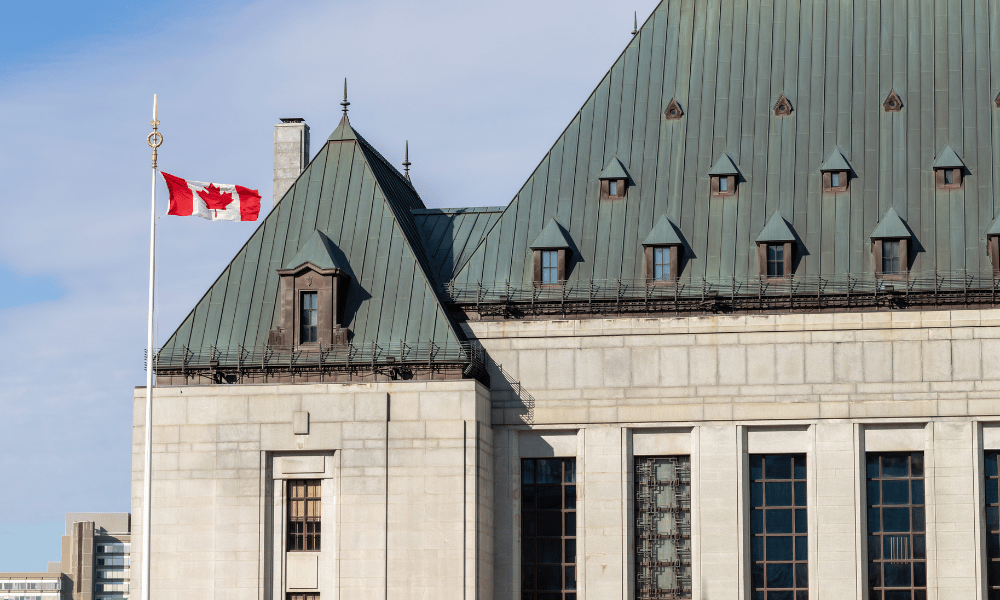
Quebec’s Bill 21, the controversial law that bars certain public-sector workers from wearing religious symbols on the job, is valid except for a provision that bars members of the provincial legislature from wearing a face covering while sitting, the Supreme Court of Canada ruled in a highly anticipated decision Friday.
To enact the law in 2019, Quebec invoked the notwithstanding clause of the Canadian Charter of Rights and Freedoms – a mechanism available to Canada’s legislative bodies since the Charter became law in the 1980s, but one long considered an exceptional measure.
In a massive ruling, three of the SCC’s justices, including Chief Justice Richard Wagner, confirmed that there are no limits to how legislatures can use the clause’s override power beyond those that are explicitly set out in the clause’s text. Therefore, Quebec had validly used the clause. The remaining four justices were split on the issue.
Four justices ruled that Canada’s courts have the power to issue declarations on whether a law aligns with the federal Charter and Quebec’s provincial counterpart, even when those laws were enacted with the use of the notwithstanding clause. However, they decided – not unanimously – against making such a declaration in this case.
“Bill 21 is rooted in Quebec’s legitimate and historical commitment to ensuring the laicity of the state in a free and democratic society,” Wagner wrote.
The high court remained split on other issues, but ultimately ruled that Bill 21 does not violate s. 28 of the federal Charter, which guarantees equality of rights to male and female persons; does not infringe the minority language educational rights protected by s. 23 of the Charter; and is not contrary to any pre-Confederation statutes or to the structural principles of Canada’s Constitution.
The court also said a Quebec Ministry of Education survey on how many school board employees wore religious symbols did not infringe the Charter.
Friday’s ruling stems from several legal challenges to Bill 21. However, the case has become one of the most closely watched in Canada’s history due to its invocation of a broader issue: the validity and scope of the notwithstanding clause.
Also known as s. 33 of the Charter, the notwithstanding clause can be invoked by Parliament or provincial or territorial legislatures to enact laws that breach the rights normally guaranteed by ss. 2 and 7-15 of the Charter. Those laws must be renewed every five years to remain in effect.
Until recently, the clause was considered an exceptional measure. While Quebec’s National Assembly adopted a policy, under the Parti Québécois, of invoking the notwithstanding clause in every piece of legislation it introduced between 1982 and 1985 as a form of political protest, the clause was only used a handful of times over the next three decades by provincial and territorial governments. The federal government has never invoked it.
But a marked shift began in 2018, when provinces began invoking the clause more frequently. Quebec, Ontario, Alberta, and Saskatchewan have invoked the clause across legislation that prevents education workers from striking, restricts gender-affirming health care for youth, and requires schools to obtain parents' consent before using students’ preferred pronouns.
After Quebec passed Bill 21, it faced lawsuits by individuals, groups, and organizations who argued the law is unconstitutional, violates the rule of law, unlawfully excludes visibly religious individuals from participating in public institutions, and more. In 2021, the Superior Court of Quebec upheld most of Bill 21 except for provisions related to English-language schools and the National Assembly; in 2024, the Quebec Court of Appeal upheld the trial judge’s ruling except for his findings on English-language schools.
On appeal, the SCC was asked to decide a wide range of questions, including whether Bill 21 is constitutionally valid, whether Quebec properly invoked the notwithstanding clause, and whether the courts can declare that Bill 21 violates Charter provisions that the clause overrides. The SCC was also asked to address whether there are limits on how the clause can be used.
Seven of the SCC’s nine justices, including Justice Sheilah Martin, who is now retired, heard arguments by the parties and a record 51 intervenors over four days in March. SCC Justice Mahmud Jamal recused himself because he previously served on the board of one of the appellants; Justice Mary Moreau did not participate to ensure an odd-numbered panel.
Friday’s ruling includes four sets of reasons, split between Wagner, Justices Suzanne Côté and Malcolm Rowe; Justice Nicholas Kasirer; Martin; and Justices Andromache Karakatsanis and Andromache Karakatsanis.
No substantive conditions for invoking notwithstanding clause
In his reasons, Wagner noted that the SCC has only directly considered the notwithstanding clause, or s. 33, one other time: in its 1988 decision in Ford v. Quebec (Attorney General). That ruling addressed the clause’s “scope and the conditions for its invocation by a legislative body,” Wagner wrote.
“In my view, and as established by Ford, s. 33 imposes only formal requirements on a legislative body, not substantive requirements,” the justice said, adding that courts must confine themselves “to verifying that these formal requirements have been met.”
Wagner said the clause leaves the courts “with no role to play in scrutinizing alleged infringements of the rights and freedoms enumerated in an override declaration.
“This interpretation is consistent with the text, the context and the purpose of s. 33: preserving a degree of parliamentary sovereignty to ensure that the legislative branch – and, by extension, the electorate – has the final say on the implementation of the rights and freedoms set out in ss. 2 and 7 to 15 of the Charter,” he added.
Because Bill 21 technically complies with the requirements set out in s. 33, Wagner concluded, Quebec invoked it lawfully.
Judicial declarations permissible in s. 33 cases
A key issue in the case concerned the courts’ power to declare that Bill 21 infringed Charter rights, even if they ultimately found that the notwithstanding clause shielded the law from being overturned. Both lower courts declined to issue such a declaration; in its ruling, the Quebec Court of Appeal noted that the SCC has never ruled on whether courts can make such declarations in the context of a notwithstanding clause dispute.
However, a ruling by the Saskatchewan Court of Appeal last year found that such declarations are permissible in cases involving the notwithstanding clause.
In that case, Saskatchewan (Minister of Education) v. UR Pride Centre for Sexuality and Gender Diversity, the appellate court explained that a judicial declaration could inform both the legislature that invoked the notwithstanding clause and its electorate, particularly when the clause’s five-year override period expires, and the legislature must consider whether to renew its use.
On Friday, Karakatsanis, O’Bonsawin, Kasirer and Martin ruled that courts retain the power to issue declarations in s. 33 cases.
“Courts have discretion to issue declarations that laws unjustifiably infringe Charter rights and freedoms, and would be of no force or effect but for the invocation of s. 33,” Karakatsanis wrote.
“Such declarations both vindicate affected individuals and promote democratic accountability by informing citizens how their representatives have chosen to temporarily override rights and freedoms,” the justice added.
“Interpreting s. 33 as the [Quebec] Court of Appeal did – precluding judicial review of legislation invoking s. 33 – undermines its five-year sunset clause aimed at ensuring that the electorate can exercise their democratic rights and express an informed opinion as to the use of s. 33 at the ballot box.”
Wagner, Côté, and Rowe disagreed, arguing that when the notwithstanding clause is invoked, courts can only ensure that use of the clause meets the applicable requirements set out in the Charter.
“Subject to these qualifications, s. 33 provides for no supervisory role for the courts and, considered as a whole, the Charter confers no power to issue a declaration of inconsistency,” Wagner wrote.
More to come.