International Bar Association finds women still facing barriers and impediments to success

Compared with over a dozen other countries, Canada fares well on gender parity and women’s participation in the legal community, but there is still work to be done to ensure that women can reach their full potential in the profession, according to a recent study by the International Bar Association.
Raising the Bar: Women in Law Project is an ongoing program begun by the IBA in 2021. A December 2024 IBA progress report on women in senior legal roles, also reported by Canadian Lawyer, found that globally, only 38 percent of women lawyers hold senior positions.
In total, the organization is taking an in-depth look at 16 countries to assess how well women are represented in private practice, in-house positions, the public sector, and the judiciary. The project examines concerns including wage gaps, gender disparity, mental health and well-being, career progression and seniority, and other issues related to women’s experiences in the profession. The project has issued reports on countries around the world, including England and Wales, Spain, Uganda, Chile, Nepal, the Republic of Korea, and Ukraine. The Canada Results Report is the 14th to be issued and was released on June 30, 2026. The remaining two reports will cover Singapore and India. The United States, which Canadians often use as a point of comparison, won’t be covered by a report.
“The situation there is so nuanced with different ethnicity questions… and now, it’s even more problematic to be asking,” says Sara Carnegie, a London, UK-based lawyer and the IBA’s director of legal projects.
Canadian picture for legal profession
With the national report in hand, Canadians can look inward to see where the profession is doing right by its women members and where it can be doing better, says Carnegie. Overall, she says that Canada “has come out as one of the best performing, one of the strongest of the 14, particularly in the public sector and the judiciary and in-house.”
In particular, she says that the conclusion is based on data points such as:
-
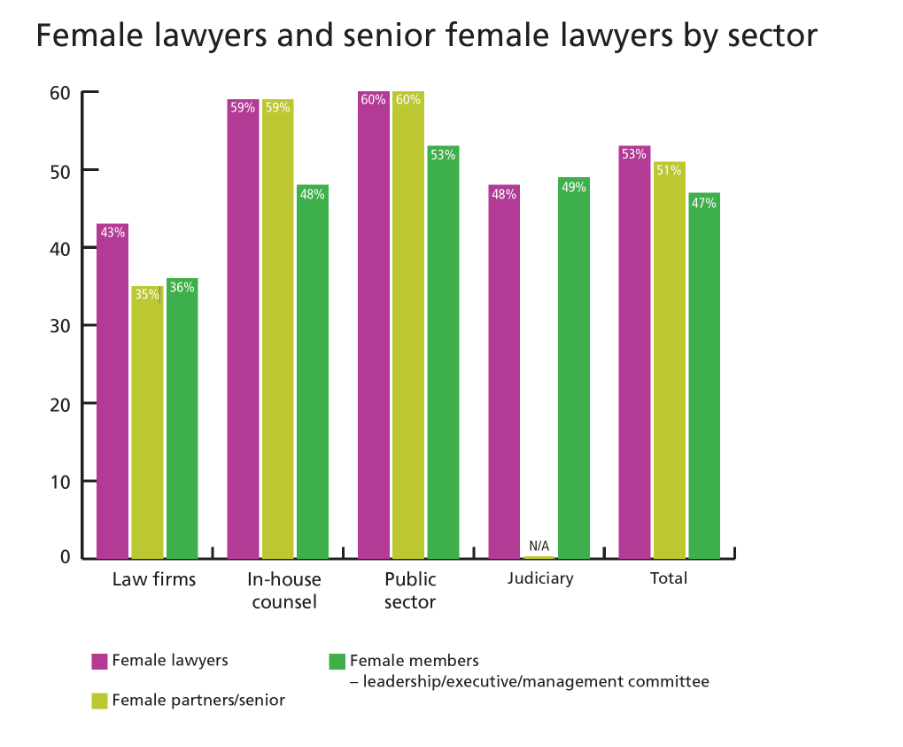
According to the IBA Canada Results Report, 53 percent of all legal professionals are women, and 51 percent of those hold senior positions
-
60 percent of all lawyers in the public sector are women, with women making up 60 percent of those in senior positions
-
60 percent of in-house counsel are women
-
93 percent of law firms, corporations, and the public sector monitor gender representation in their workplaces generally and at a senior level within their organization
-
48 percent of the judiciary are women, with 49 percent working in leadership positions
-
Five of the nine Supreme Court Justices were women at the time the study was conducted.
Research from Norton Rose Fulbright's chief people officer has similarly found that sponsorship and work allocation in the leadership pipeline for women and those from diverse backgrounds are among the most effective tools for advancing parity. Regarding women in the private sector, Carnegie says that Canadian results are comparable to those of other countries involved in the study, where it’s common to find large firms in which 40 to 45 percent of lawyers are women, and only about one-third of those reach senior levels. The Canadian data show that women represented 43 percent of lawyers in law firms but only 35 percent as partners and 36 percent on law firm boards, executive, and management committees.
Effective initiatives for gender inclusion
Monitoring their hiring and promotion practices is one way Canadian firms have attempted to be more inclusive of women. The figure mentioned above – 93 percent keeping an eye on gender representation – is what Carnegie describes as “one of the highest of the countries that we’ve studied.”
While it’s one approach that seems to have proven itself, there’s another one that the study’s respondents draw particular attention to: target setting.
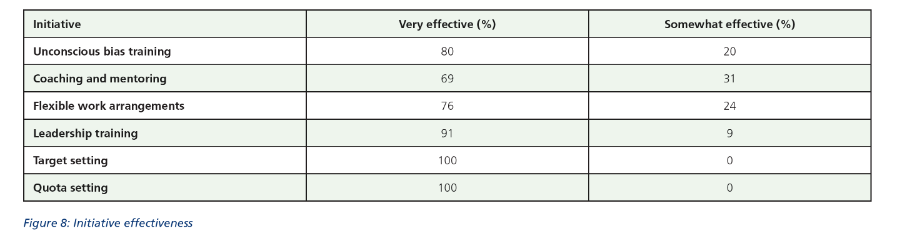
Carnegie is quick to point out, however, that effective doesn’t necessarily mean popular. She notes that only 36 percent of organizations set targets, but 100 percent of respondents say doing so is effective in leading them to where they want to be in achieving gender parity and representation.
“It’s a brutal thing which I know is not necessarily agreed with by some of our other jurisdictional studies, but nonetheless it’s an interesting finding in Canada.”
Pressures and barriers for women lawyers
The report references past studies, including the 1993 Touchstones for Change report, which described the barriers Canadian women faced when entering the profession and as their careers progressed. As the Canada result report describes them, Touchstones found “individual and systemic discrimination operated through sexual harassment, discrimination in the assignment of work and opportunities for advancement, and inadequate accommodation for childcare and other family responsibilities. The report also highlighted the disproportionate impact of these barriers on women lawyers.”
Thirty years later, Carnegie says women are still facing many of the same barriers, especially those employed in the private sector. She says pressures to meet billable-hour targets have worsened, and flexibility has declined as return-to-office measures are implemented, despite the pandemic proving that work-from-home policies better support people (especially women) with caregiving responsibilities. She stresses that the pay gap and pay equity problems persist.
The IBA report also references a 2021 University of Sherbrooke study that looks at lawyers’ mental health and wellbeing, which found that women in the legal profession reported more psychological stress and feelings of burnout than their male colleagues. Carnegie says this finding mirrors historic LawCare reporting about UK-based women lawyers seeking mental health support, as well as a more recent study demonstrating that over the past five years, women have continued to suffer pressures related to the job, resulting in “85 percent [having] experienced health and wellbeing issues that had impacted their work. This included stress (83 percent), burnout (53 percent), and anxiety (71 percent), with many respondents dealing with multiple issues.”
It’s a problem the profession needs to contend with in Canada and throughout the world, says Carnegie. “Women are generally saying they love legal practice, they love the law and the work, but they struggle with the culture of legal workplaces. It’s that workplace question again that has created a worrying level of burnout.”
IBA recommendations to structural and cultural change for gender equality
Conducting national studies is just one part of the Raising the Bar project. In fact, the IBA describes them as phase I. The results from phase II, a global survey of 5,000 women from 100 countries, were published in March 2026. As part of the report, the IBA issued six recommendations about how firms, especially small, private ones, can enact structural and cultural change, normalize flexible working models, support women’s wellbeing and life stages, and build sustainable career pathways for women. Currently, IBA advisory groups and individual members are developing initiatives and generating some practical activities based on those recommendations.
The association is also working on guidance for legal workplaces on professional well-being, which Carnegie expects will be adopted in October 2026, as well as updates to its Diversity and Inclusion Toolkit, which should be available in 2027.
“We can’t mandate anything. We’re not an organization that has any mandatory powers. We can simply advise on good practice. We can raise awareness and produce toolkits that provide our members, and the wider profession, with some form of guidance, but I think it’s important that the IBA stands for something powerful here.”
Infographics courtesy of the International Bar Association.